
Bone Grafting for Dental Implants: Do You Need One?
- Aug 26, 2026
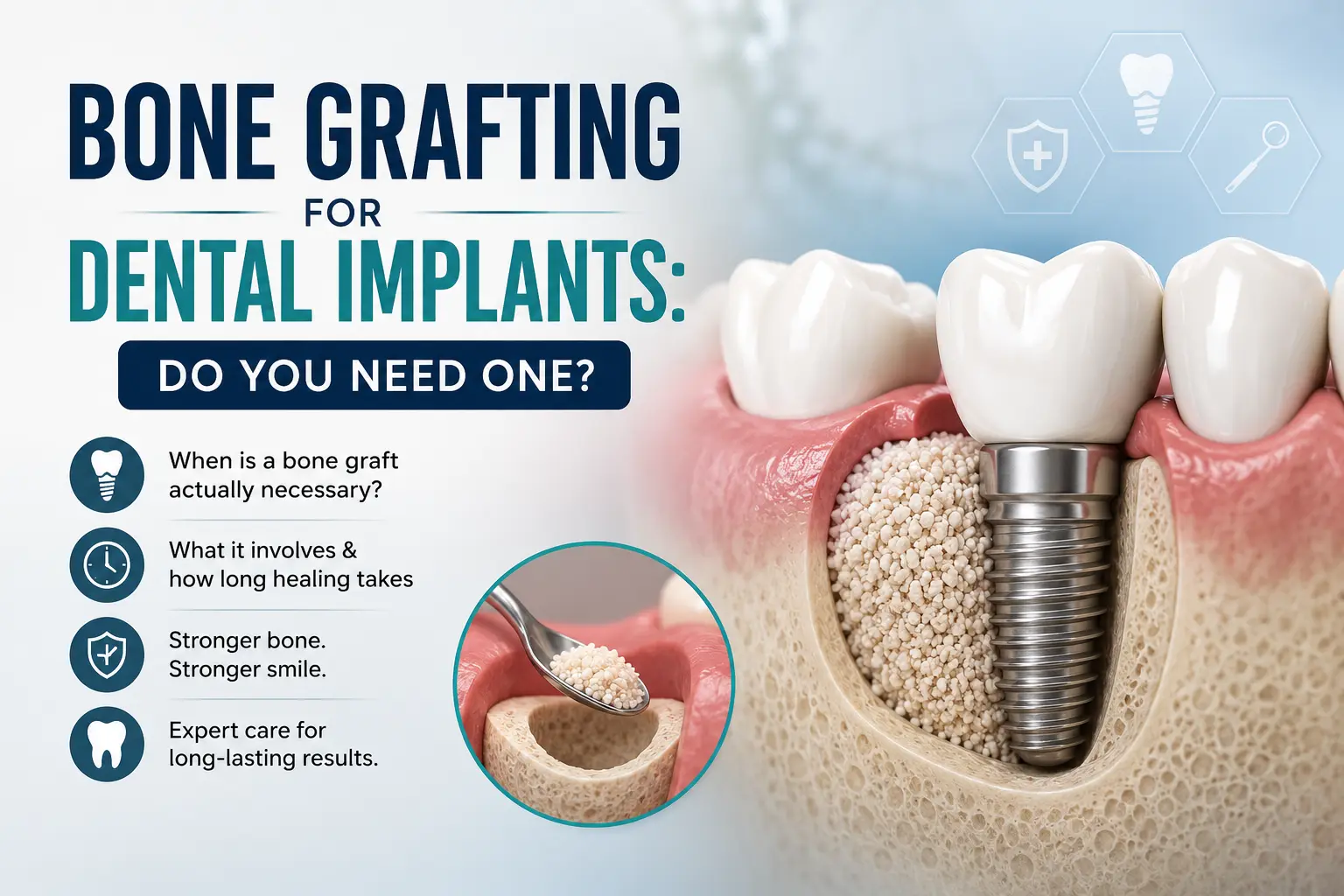
If you’re researching dental implants, you’ve probably come across the term “bone graft” and wondered whether it applies to you. It’s a fair question, and the honest answer is that it depends. Not everyone who needs a dental implant needs a bone graft first. It comes down to how much healthy bone is already there to support the implant, something only a clinical exam and imaging can actually determine.
Some patients are surprised to learn they need one when they’d assumed a straightforward implant placement; others are relieved to find out their bone is in better shape than they expected and no grafting is necessary at all.
This guide walks through when grafting is genuinely necessary, what the different types involve, how long healing actually takes, and how modern implant planning can sometimes reduce the need for one in the first place.
What Is a Dental Bone Graft?
A dental bone graft adds material to the jaw, either your own bone, donor bone, or a synthetic substitute, to rebuild volume and density that’s been lost. According to the American Association of Oral and Maxillofacial Surgeons, a bone graft is bone taken from the patient, a donor (human or animal), or manufactured from synthetic materials, and it either directly replaces missing bone or provides a scaffold your own bone can grow onto over time.
The goal is straightforward: create a foundation strong enough for an implant to properly fuse to the bone, a process the AAOMS describes as osseointegration, something with no real shortcut around it once an implant is placed. Without enough bone, that fusion doesn’t happen reliably, which is why grafting comes up as often as it does in implant treatment planning.
Do You Actually Need a Bone Graft for Your Implant?
Not automatically, and this is worth saying clearly because a lot of people assume a graft is a required step for every implant. It isn’t. Whether you need one depends entirely on how much bone remains at the specific site where the implant will be placed.
A few common reasons bone has been lost by the time someone considers an implant:
- Long-term Missing Teeth: Bone needs stimulation from a tooth root to stay strong. Once a tooth is gone, the surrounding bone gradually shrinks, sometimes over years, without any obvious symptoms along the way. Many patients don’t realize this has happened until imaging reveals it during an implant evaluation
- Gum Disease: Untreated periodontal disease can erode the bone that supports nearby teeth, sometimes affecting a wider area than just the site of the missing tooth
- An Old Extraction Without Socket Preservation: If a tooth was removed without a graft placed at the time, the socket can collapse inward as it heals, reducing the bone available for an implant later, even if the extraction occurred years before an implant was ever considered
- Trauma or Injury: A fractured jaw or forcefully knocked-out tooth can sometimes damage more bone than is immediately obvious
The only reliable way to know where you stand is a clinical exam paired with imaging, typically a 3D scan that shows your provider exactly how much bone is present and where. Guessing based on how a tooth was lost or how long ago it was lost isn’t accurate enough on its own.
Types of Bone Grafts
Bone graft material generally falls into four categories, and your provider will recommend one based on the specific defect and your overall health.
Graft Type | Source | Notes |
Autograft | Your own bone, usually harvested from another site in the mouth or jaw | Avoids rejection risk; requires a second surgical site |
Allograft | Donor human bone, processed and sterilized | One of the most commonly used options; no second surgical site needed |
Xenograft | Donor animal bone, commonly bovine | Processed and sterilized; serves as a scaffold for your own bone to replace over time |
Alloplast | Synthetic, manufactured material | Biocompatible; often used for smaller defects |
There isn’t a single best option across the board. The right choice depends on the size of the defect, your health history, and your provider’s clinical judgment.
Common Types of Grafting Procedures
It’s worth separating the material used from the type of procedure being performed, since these often get blurred together in online content.
Socket preservation is placed immediately after a tooth extraction, right into the empty socket, to prevent the surrounding bone from collapsing as it heals. This is often the simplest and fastest-healing type of graft.
Ridge augmentation rebuilds bone along the jaw ridge in an area that’s been missing teeth for longer, where more significant shrinkage has already occurred.
Sinus lift (sinus augmentation) adds bone to the upper jaw, specifically in the back, where the maxillary sinuses sit close to the jawbone. When there isn’t enough bone height between the sinus and the jaw to safely place an implant, this procedure creates the needed space and fills it with graft material.
How Long Does Bone Graft Healing Take?
Most patients wait roughly three to six months between a bone graft and implant placement, giving the graft material time to fully integrate with the surrounding bone. Healing happens in stages, and knowing what to expect at each point makes the waiting period easier to manage:
- The first one to two weeks involve initial clot formation and the normal swelling and tenderness that come with any oral surgery.
- Weeks two through six bring new blood vessel growth into the graft site, supplying the nutrients needed for bone regeneration to actually begin.
- The following few months are when the real bone formation happens, as your body’s own bone-building cells gradually replace the graft material with new, living bone. This is the slowest and most important stage, and it’s not something that can be rushed with medication or extra care; it simply takes the time it takes.
- Later stages involve new bone remodeling and maturation to match the surrounding jaw, which your provider checks before clearing you for implant placement.
Sinus-specific grafts can take longer to fully mature, sometimes four to twelve months depending on the extent of the augmentation, according to the American Academy of Periodontology. A commonly cited outer window in clinical guidance is around 12 months between graft and implant placement; waiting significantly beyond that may warrant a fresh evaluation before moving forward, since healing can vary with individual health, age, and graft type.
What Happens If You Skip a Needed Bone Graft?
If there genuinely isn’t enough bone at the implant site and a graft is skipped anyway, the implant is less likely to properly fuse with the surrounding bone. That can mean instability, a higher risk of implant failure, or complications down the line that are more difficult and expensive to address than the original graft would have been.
This isn’t meant to be alarming; it’s meant to explain why a provider makes the recommendation. A graft isn’t suggested as an upsell; it’s suggested because the underlying bone genuinely isn’t there yet to support a stable, long-lasting implant.
What Happens During the Bone Grafting Procedure?
Understanding the general process helps make grafting feel less abstract. After imaging confirms grafting is needed, the procedure itself is typically performed under local anesthesia, and sedation options are available for patients who feel anxious about the idea of oral surgery.
The graft material, whichever type fits your case, is placed at the site that needs additional bone, sometimes alongside a protective membrane that helps keep the material in place as healing begins.
In many cases, particularly with socket preservation, this happens at the same appointment as an extraction, so it doesn’t necessarily require a separate visit. For more involved procedures like a sinus lift, the process is more technical, requiring careful access to the sinus area, but the underlying goal is the same: to create sufficient stable bone volume for a future implant to succeed.
Recovery from the graft itself is usually more manageable than people expect. Mild swelling and tenderness in the first week or two are normal, and most patients return to their regular routine within a few days, well before the graft has finished maturing beneath the skin.
Can You Avoid Needing a Bone Graft?
In some cases, yes. This is where the implant planning approach actually matters. Flexible, individualized implant placement, like the approach used in All-on-X treatment, can sometimes work around limited bone by angling implants toward areas of the jaw where bone is naturally denser, rather than placing every implant straight down regardless of what’s underneath. In the right case, this can reduce or even eliminate the need for a separate grafting procedure.
We’ve covered this planning philosophy in more depth in our guide comparing All-on-4 vs. All-on-X dental implants, including how implant count and placement get tailored to each patient’s actual anatomy.
This isn’t a guarantee for every patient; some cases genuinely need grafting regardless of the planning approach, but it’s part of why an individualized evaluation matters more than a one-size-fits-all answer.
Already Had a Bone Graft But Haven't Gotten Your Implant Yet?
If you’ve already had a bone graft and it’s healed, but you haven’t moved forward with the implant itself, that’s a related but genuinely different question: how long a healed graft can sit before it needs to be reassessed, and what your options are if you’ve waited longer than expected. We cover that scenario in detail in a separate guide, since it deserves its own full answer rather than a quick aside here.
What to Expect at Your Consultation
A consultation is where the “do I need a graft” question actually gets answered, not guessed at. That typically starts with a review of your health history, a clinical exam, and 3D imaging to see exactly how much bone is present at the site where an implant is being considered. From there, your provider can walk you through whether grafting is needed and, if so, which type and approach are best for your specific case.
If you’re ready to find out where you stand, schedule a consultation at our Marietta or Newnan office.
Final Thoughts
Not every implant needs a bone graft, but for the ones that do, understanding why makes the process a lot less intimidating. The only way to know where you actually stand is a real evaluation, not a guess based on what you’ve read online.
Schedule your consultation with Dr. Kumar Patel at our Marietta or Newnan location to find out whether a bone graft is part of your path to a dental implant.
FAQ:
1. Do I need a bone graft for a dental implant?
Not necessarily. It depends on how much healthy bone remains at the implant site, which is determined through a clinical exam and imaging, not on assumptions about how or when a tooth was lost.
2. What is a bone graft made of?
It can be your own bone, donor human bone, donor animal bone, or a synthetic biocompatible material. The right choice depends on the size of the defect and your provider’s clinical judgment.
3. How long does it take for a bone graft to heal before an implant?
Most patients wait about 3 to 6 months for the graft to fully integrate with the surrounding bone. Sinus-specific grafts can take longer, sometimes up to a year, depending on the extent of the procedure.
4. What's the maximum time between a bone graft and implant placement?
A commonly cited outer window is around 12 months. Waiting significantly longer than that may warrant a fresh evaluation, since healing outcomes can vary based on individual health and the extent of graft integration.
5. What happens if I don't get a needed bone graft?
Skipping a genuinely needed graft increases the risk that the implant won’t fuse properly with the surrounding bone, which can lead to instability or implant failure over time.
6. Can I get a dental implant without a bone graft?
Yes, if there’s enough existing bone to support it, or in some cases, if a flexible implant placement approach can work around limited bone by angling implants toward denser areas of the jaw. Whether that applies to you depends on your specific anatomy.