
All-on-4 vs. All-on-X Dental Implants: What's the Real Difference?
- Aug 26, 2026
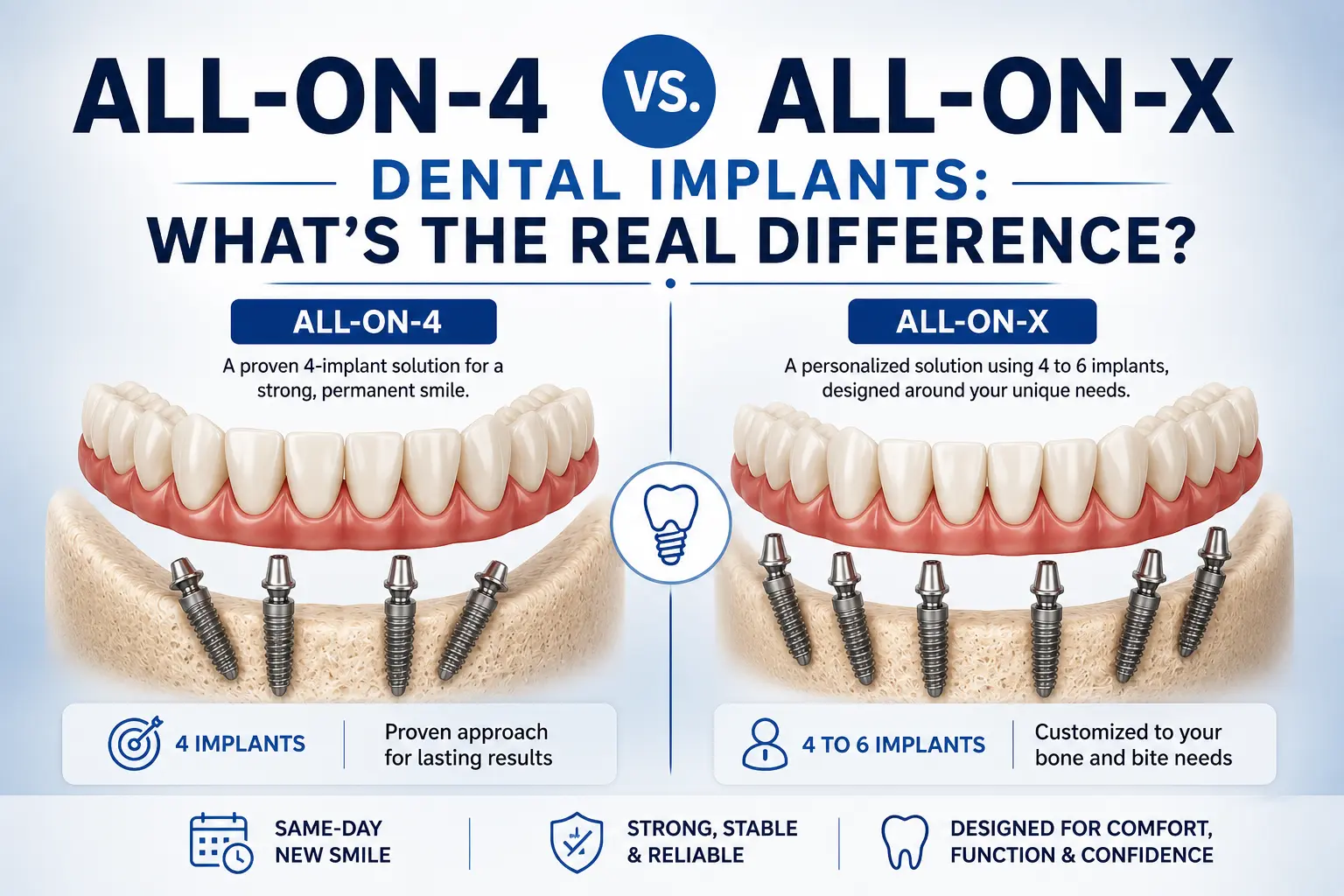
All-on-4 uses exactly four implants to support a full arch of fixed teeth, while All-on-X is a broader approach that uses four to eight or more implants, depending on your bone density and bite forces. Both replace an entire arch with a permanent, implant-supported bridge. The difference is that All-on-4 is a fixed protocol, whereas All-on-X is customized to each patient.
This guide breaks down what actually separates the two, what the published research shows about long-term success, and how our All-on-X full-arch tooth replacement approach works at Simaya Prosthodontics.
What Is All-on-4?
All-on-4 refers to a specific full-arch implant technique: four implants support an entire arch of replacement teeth, two placed vertically toward the front of the jaw and two placed at an angle toward the back. That angled placement maximizes contact with the bone that’s actually available, which often reduces or eliminates the need for a separate bone grafting procedure before treatment.
It’s worth noting that “All-on-4” is a registered trademark associated with a specific implant system. We use the term here to explain the general technique it popularized, not to suggest that a specific branded system is what we use in our practice.
What Is All-on-X?
All-on-X is the more flexible evolution of the same underlying concept. Instead of a fixed rule of exactly four implants, the “X” represents a number, typically four to six, determined by your individual bone density, bite force, and long-term stability needs. Some patients are excellent candidates for a four-implant approach.
Others benefit from additional implants for extra support, particularly with more significant bone loss or a heavier bite.
This is the approach we offer at Simaya Prosthodontics. Rather than fitting every patient into the same four-implant framework, the number and placement of implants is planned around what your jaw and bite actually need.
All-on-4 vs. All-on-X: Side-by-Side Comparison
Feature | All-on-4 | All-on-X |
Implant count | Fixed at 4 | Typically 4 to 6, based on individual need |
Treatment approach | Standardized protocol | Individualized to bone density and bite force |
Bone grafting | Often avoided through angled placement | Same goal, with more flexibility for complex cases |
Same-day provisional teeth | Commonly available | Commonly available |
Best suited for | Patients with adequate anterior bone and standard bite forces | Patients with variable bone quality, heavier bite forces, or more complex cases |
All-on-4 vs. All-on-6: Does More Implants Mean Better Results?
More implants doesn’t automatically mean a better outcome; it means more support where a specific case calls for it. A 2026 systematic review and meta-analysis pooling data from 55 studies found implant survival rates of 99.20% for All-on-4 and 100% for All-on-6 at one year of follow-up; 99.66% and 98.55%, respectively, between one and five years; and 98.14% and 97.50%, respectively, at five years or more. In other words, both approaches perform extremely well in the long term, and the differences between them are small.
Where additional implants tend to matter most is in specific clinical situations: a patient with more significant bone resorption, someone with a particularly strong bite, or a case where the added implants provide an extra margin of stability for long-term durability.
A separate systematic review focused specifically on All-on-4 found a mean cumulative implant survival rate of 99.0% and a prosthesis survival rate of 99.9% at 36 months, based on pooled data from more than 4,800 implants, reinforcing that the four-implant approach is well supported by the evidence when it fits the case.
What the Research Actually Shows About Success Rates
It’s easy to find a success rate number online without knowing where it came from. Here’s what’s actually behind the figures for full-arch implants:
- A pooled analysis of 55 studies found short-term survival rates above 99% for both All-on-4 and All-on-6, with rates remaining above 97% even at 5-year or longer follow-up.
- A study published in the Journal of the American Dental Association followed All-on-4 patients for up to 10 years and reported cumulative implant-related success of 94.8% and prosthesis survival of 99.2% over that period.
These figures come from the peer-reviewed literature across many patients and practices, not any single provider.
Separately, and worth distinguishing clearly, our implant dentistry page references Simaya Prosthodontics’ own reported success rate of over 95%, which reflects our specific patient outcomes rather than the broader research figures above. Both are worth knowing, but they’re two different things: what the published literature shows across the field, and what one specific practice has achieved with its own patients.
For a broader look at how implant longevity works in general, we’ve also covered this in more depth in our guide to how long dental implants last.
How Does the All-on-X Procedure Actually Work?
Understanding the general process helps set realistic expectations, even though your exact plan is built around your own imaging and evaluation.
Treatment typically begins with a comprehensive workup: a review of your health history, a clinical exam, and 3D imaging to map your jawbone in detail. This planning stage is what determines how many implants your case needs and exactly where they’ll be placed; it’s not decided on the day of surgery.
On the day of the procedure, any remaining problematic teeth are removed if needed, and the implants are placed according to the plan developed from your imaging. For many patients, a fixed, temporary set of teeth is attached the same day, so you’re not left without teeth during healing. This temporary prosthesis lets you eat, speak, and function normally while the implants fuse with the jawbone underneath, a process called osseointegration that typically takes several months.
Once healing is complete, the temporary prosthesis is replaced with your final, custom-fabricated permanent teeth, designed to match your bite, facial structure, and aesthetic goals. The full timeline from initial consultation to final prosthesis generally spans a few months, though the fixed temporary teeth mean you’re not without a functional smile during that period.
How Do You Know Which One Is Right for You?
There’s no way to answer this from a blog post alone, and that’s by design; the right approach genuinely depends on your specific anatomy. A few of the factors that go into this decision:
- Bone density and volume. More available bone generally supports more placement options; less available bone may call for angled implants or additional support to achieve the same stability.
- Bite force. A heavier bite, whether from habit, jaw structure, or grinding, may benefit from additional implants distributing the load more evenly across the arch.
- Whether grafting can be avoided. Both approaches aim to minimize grafting where possible, but the right number and placement of implants affects how achievable that actually is for your specific jaw.
- Long-term prosthetic goals. How you want your final restoration to look, feel, and function factors into planning from the start, including material choice and how the prosthesis is designed to distribute daily wear over the years ahead.
- Overall health and healing capacity. Factors like bone quality, gum health, and any relevant medical history all play into what implant plan will hold up best over time.
This kind of individualized treatment planning is exactly what prosthodontists specialize in. Unlike a general dentist or an implant-focused surgical practice, a prosthodontist’s training centers specifically on restorative and full-arch planning, matching the technique to the person rather than the person to a fixed protocol. That’s a meaningful distinction when the decision between four and six implants can shape how your restoration performs for decades.
How Does All-on-X Compare to Traditional Dentures?
It’s worth stepping back for a moment because some patients researching All-on-4 and All-on-X are still deciding between fixed implants and removable dentures. Both All-on-4 and All-on-X are fixed solutions, meaning the replacement teeth are permanently anchored to implants and don’t come out, unlike a traditional denture that rests on the gums and can shift or require adhesive. If you’re still weighing that broader decision, we’ve covered it in more detail in our guide to dental implants vs. dentures.
What Does All-on-X Cost?
Cost is one of the most common questions we hear, and the honest answer is that it depends on your specific case, the number of implants needed, and your current oral health.
At Simaya Prosthodontics, All-on-X treatment starts at $18,500 per arch (limitations apply), and terms and conditions may vary depending on the complexity of the individual case, so this figure is a starting point for discussion, not a guaranteed final price.
You may see wide-ranging national estimates elsewhere online; full-arch implant treatment can vary considerably by provider, region, and case complexity. Rather than relying on a generic average that may not reflect your actual situation, the most accurate number comes from an in-person evaluation.
Cost shouldn’t be the reason a needed treatment stays out of reach. We offer flexible financing, and we work with major dental insurance providers to help you get the most from your benefits.
During your consultation, our team can walk you through your specific plan and financing options before you commit to anything.
What to Expect at Your Consultation
A consultation typically starts with a comprehensive evaluation: a review of your health history, a clinical exam, and imaging to assess your bone structure and overall oral health. From there, we walk through what we’re seeing and why a particular implant number or placement makes sense for your specific case, so you understand the reasoning behind the recommendation rather than just receiving one.
If you’re ready to find out which approach fits your situation, schedule a consultation at our Marietta or Newnan office.
Final Thoughts
All-on-4 and All-on-X both offer a fixed, permanent alternative to removable dentures; the real question isn’t which one is objectively better, it’s which one fits your bone structure, bite, and goals. That’s a conversation best had in person, with imaging and a full evaluation in front of you.
Schedule your consultation with Dr. Kumar Patel at our Marietta or Newnan location to find out which approach is right for you.
FAQ:
1. What's the difference between All-on-4 and All-on-X?
All-on-4 is a specific technique using exactly four implants in a standardized arrangement. All-on-X is the more flexible evolution of the same concept, using four to six implants or more, depending on the individual patient’s bone density and bite force.
2. What are All-on-X dental implants?
All-on-X is a full-arch tooth replacement approach that uses a tailored number of implants, typically four to six, to support a fixed, non-removable set of replacement teeth for an entire upper or lower arch.
3. Is All-on-6 better than All-on-4?
Not universally. Research shows both approaches achieve high survival rates, with only small differences between them. Additional implants tend to be most helpful in specific situations, such as significant bone loss or a heavier bite, rather than being a better choice for everyone.
4. What is the success rate of All-on-X dental implants?
Published research shows survival rates above 99% in the first year for both four- and six-implant approaches, with rates remaining above 97% at 5 years or more of follow-up. Simaya Prosthodontics separately reports a success rate of over 95% across its own patients.
5. How much does All-on-X cost?
At Simaya Prosthodontics, All-on-X treatment starts at $18,500 per arch, with the final cost depending on the complexity of the individual case. Limitations and terms may apply, and a consultation is the most accurate way to get a number specific to your case.
6. How long does All-on-X treatment take?
Many patients receive a fixed, temporary set of teeth the same day as implant placement. The final, permanent prosthesis typically follows after a healing period, during which the implants integrate with the jawbone.