
Dental Implants vs. Dentures: Which Is the Better Choice for You?
- May 21, 2026
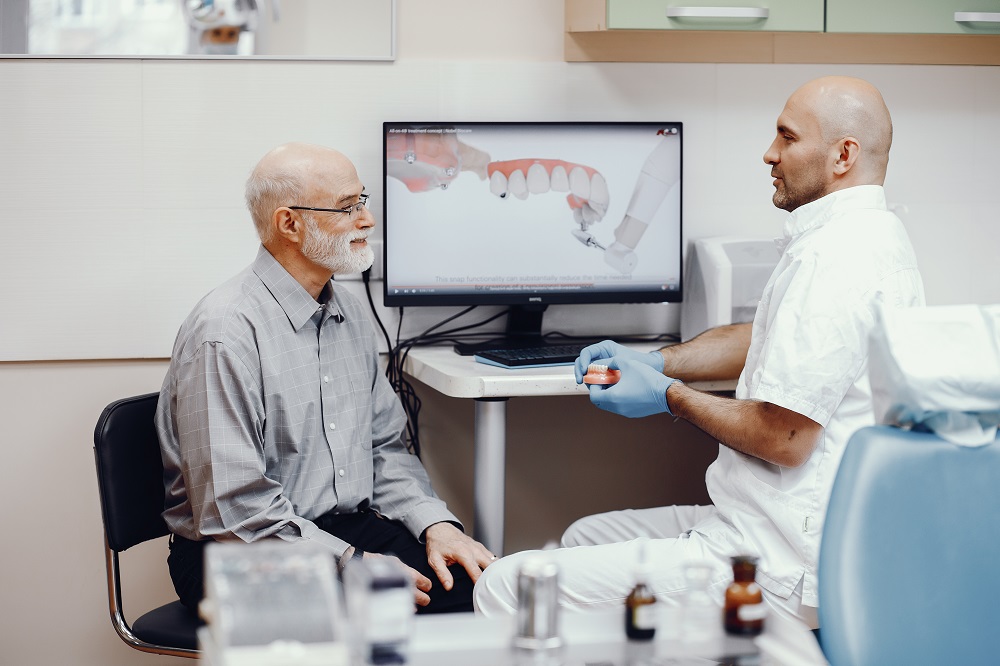
Dental implants are better for most people who want a permanent, stable replacement, while dentures are better for those who need a lower upfront cost or can’t undergo surgery. Dental implants are anchored in the jawbone, preserve bone, and can last 20+ years. Dentures rest on the gums, cost less initially, and typically need replacing every 5 to 10 years. Dr. Kumar Patel, a board-certified prosthodontist with 20+ years of experience, reviews this comparison and covers cost, comfort, eating ability, and long-term value.
Dental Implants vs. Dentures: A Side-by-Side Comparison
Before diving into the details, here is a direct comparison of how these two options stack up across the factors that matter most to patients.
Before diving into the details, here is a direct comparison of how these two options stack up across the factors that matter most to patients.
Feature | Dental Implants | Dentures |
Appearance | Natural-looking, fixed | Visible, may shift |
Comfort | Feels like real teeth | Can cause soreness |
Lifespan | 20 to 30+ years | 5 to 8 years |
Bone Preservation | Yes, stimulates bone | No, bone loss continues |
Maintenance | Brush and floss normally | Nightly removal and soaking |
Upfront Cost | $3,000 to $6,000 per tooth | $1,500 to $3,000 full set |
Long-Term Cost | Lowest over time | Highest due to replacement |
Surgery Required | Yes | No |
Best For | Most patients | Budget-limited or low bone density |
The table above gives you the broad picture. The sections below give you the full context you need to make a confident decision.
Dental Implants vs. Dentures: Cost Comparison
Cost is often the first question patients ask, and it deserves a thorough answer because the upfront number and the lifetime number tell very different stories.
Upfront costs for dental implants> typically run between $3,000 and $6,000 per tooth, which includes the implant post, the abutment, and the crown. For patients who need a full arch replaced, an All-on-4 procedure generally ranges from $20,000 to $30,000 per arch. That number is significant, and it’s the reason many patients initially lean toward dentures.
Upfront costs for dentures> are considerably lower. A complete set of traditional dentures typically ranges from $1,500 to $3,000. For patients working within a tight budget, that difference is real and worth acknowledging.
Where the picture shifts is in long-term cost. Dentures need to be replaced every five to eight years as the shape of your jaw changes over time. When you factor in multiple replacements, adjustments, adhesives, and cleaning products over a decade or more, the total cost of dentures often exceeds what you would have spent on implants.
A rough ten-year analysis illustrates this clearly. A patient who spends $2,000 on dentures and replaces them once in that period, along with routine maintenance, may spend $5,000 or more. A patient who invests in implants and maintains them with normal brushing and flossing may spend nothing beyond the initial cost.
At Simaya Prosthodontics, we accept CareCredit financing and work with most major insurance providers including Delta Dental, Cigna, MetLife, Humana, BCBS, and Guardian. Financing options make it possible for many patients to access implants at a monthly cost that fits their budget even when the upfront number feels out of reach.
Pros and Cons of Dental Implants
The Case for Implants
Dental implants are widely regarded as the gold standard in tooth replacement, and the clinical reasons for that designation are well established.
Implants look, feel, and function like natural teeth. Once the process is complete, most patients report that they forget the implant is there. There are no wires, no adhesives, no removal at night. You eat what you want, speak naturally, and care for them exactly as you would your natural teeth.
Beyond aesthetics and comfort, implants preserve the jawbone. This is a point that does not get enough attention in patient conversations. When a tooth is lost and nothing replaces the root, the bone beneath that space begins to resorb. Over time, this causes the face to take on a sunken appearance and creates complications for any future dental work. An implant post integrates directly with the bone, stimulating it the way a natural tooth root would and preventing that deterioration.
Implants also carry a 97 percent success rate at ten years, making them one of the most reliable procedures in modern dentistry. They are the most cost-effective tooth replacement option over a lifetime, and the confidence boost patients describe after completing treatment is consistently one of the most significant quality-of-life improvements they report.
The Limitations of Implants
Implants are not suitable for every patient in every situation. The procedure requires surgery and a healing period of three to six months during which the implant integrates with the bone, a process called osseointegration. This timeline is not negotiable, and patients who need immediate results may find it difficult to wait.
Some patients have bone density levels that are insufficient to support an implant without additional preparation. A bone graft can address this in many cases, but it adds time and cost to the overall process. Patients with uncontrolled diabetes or certain other systemic health conditions may also face candidacy challenges, which is why a thorough evaluation with a prosthodontist is essential before making any decision.
The upfront cost remains the most common barrier, though as discussed above, financing options have made implants accessible to a much broader range of patients than in previous decades.
Pros and Cons of Dentures
The Case for Dentures
Dentures serve a genuine and important role in tooth replacement, and for the right patient they are a practical and reasonable solution.
The most obvious advantage is cost. Dentures require no surgery, no healing period, and no waiting for osseointegration. From consultation to delivery, the process typically takes a matter of weeks rather than months. For patients with low bone density that cannot support implants, or for those for whom surgery presents a medical risk, dentures may be the most appropriate path.
They are also fully reversible in the sense that no permanent changes are made to your anatomy. If a patient’s health or financial situation changes in the future, dentures can be transitioned to implants in many cases.
The Limitations of Dentures
The challenges of dentures are well known to anyone who has worn them or watched a family member navigate them. They can slip, click, or shift during speaking and eating. Sore spots develop where the appliance rubs against the gum tissue. Adhesives are required for many patients to feel secure, and that security is still not the same as a fixed tooth.
The bone loss issue bears repeating because it has long-term consequences beyond aesthetics. Dentures rest on the gum surface and do nothing to stimulate the underlying bone. Resorption continues beneath them, which is part of why dentures require refitting and eventual replacement as the jaw changes shape over time.
Dietary restrictions are a real and often underappreciated quality-of-life issue. Hard foods, crunchy foods, and sticky foods become difficult or impossible for many denture wearers. The speech changes that can accompany new or ill-fitting dentures are another adjustment patients frequently mention.
Types of Tooth Replacement: Comparing All Options
Not every patient is choosing between full implants and full dentures. Here is how the other major options in the implant and denture family compare.
Snap-In Dentures vs. Dental Implants
Snap-in dentures, also called implant-retained dentures, represent a middle ground between traditional dentures and full fixed implants. Two to four implant posts are placed in the jaw to serve as anchors for a removable denture. The denture snaps onto these anchors for significantly more stability than a conventional denture, but it is still removed for nightly cleaning.
The cost is generally in the range of $6,000 to $12,000, which is less than a full fixed implant solution. For patients who want improved stability without the full commitment of fixed implants, snap-in dentures are worth discussing with your prosthodontist.
Permanent Dentures vs. Dental Implants
The term “permanent dentures” typically refers to a fixed implant-supported prosthesis such as an All-on-4 or All-on-6 restoration. Despite the word “dentures” in the name, this is not a removable appliance. It is anchored to implant posts and functions as a fixed replacement for an entire arch.
Patients who are researching permanent dentures are often in the same decision space as those looking at full-arch implants, and the consultation process is largely the same.
Partial Dentures vs. Dental Implants
When only some teeth are missing rather than a full arch, a partial denture fills the gaps with a removable appliance that clasps onto remaining natural teeth. Single implants are generally more comfortable, more stable, and better for the health of adjacent teeth. Partial dentures can accelerate wear on the teeth they clasp onto, which is a factor worth weighing in the long-term picture.
Dentures vs. Implants for Seniors
Age alone is not a disqualifier for dental implants. The relevant factors are bone density and overall systemic health, not the number on a patient’s birth certificate. Many patients in their 70s and 80s are excellent implant candidates and go on to enjoy decades of benefit from the procedure.
Dr. Patel conducts thorough evaluations at both the Marietta and Newnan locations to assess candidacy based on an individual patient’s health profile rather than age. If you are a senior who has been told implants are not an option for you, a second opinion from a prosthodontist may be worthwhile.
Which Is Better: Dental Implants or Dentures?
The honest answer is that the right choice depends on your individual health, budget, and priorities. Here is a structured way to think through it.
Choose implants if you want a permanent, natural-feeling solution, you are in reasonably good general health, and you are looking at the long-term picture rather than only the upfront cost.
Choose dentures if budget is the primary constraint right now, or if bone density or health conditions make implant surgery inadvisable at this time.
Consider snap-in dentures if you want more stability than traditional dentures provide but are not yet ready or able to invest in a full fixed implant solution.
As Dr. Patel puts it: “As a prosthodontist with over 20 years of experience, I always recommend a thorough evaluation before deciding. The right answer is personal and it cannot be determined by a comparison chart alone. What matters is your bone health, your medical history, your lifestyle, and your goals.”
Can You Switch from Dentures to Dental Implants?
Yes, and this is a question that comes up frequently from patients who got dentures years ago and are now wondering if implants are still an option.
Existing denture wearers are often excellent implant candidates. The key variable is how much bone loss has occurred since the original tooth loss. If significant resorption has taken place over years of denture wear, a bone graft may be necessary before implants can be placed. This adds time and cost to the process, but it does not automatically disqualify a patient.
The typical pathway looks like this: consultation and bone evaluation, bone grafting if needed, implant placement, healing and osseointegration, and final restoration. The full timeline can range from six to eighteen months depending on bone health.
Dr. Patel offers same-day evaluations at both the Marietta and Newnan locations. If you’ve been wearing dentures and have wondered whether implants are still within reach, the first step is a conversation.
The Right Answer Starts with the Right Evaluation
There is no universal winner between implants and dentures. There is only the right choice for your health, your jaw, your budget, and your goals. What this guide can do is help you walk into that conversation informed.
At Simaya Prosthodontics, Dr. Kumar Patel and the team bring over 20 years of specialized prosthodontic expertise to every evaluation. Both the Marietta and Newnan locations offer same-day consultations to help you understand your options with clarity and confidence.
Call us today or book online: Marietta, GA | Newnan, GA
Your consultation is the starting point. Everything else follows from there.
FAQ:
1. Are dental implants better than dentures?
For most patients who are medically eligible, implants provide superior comfort, function, longevity, and bone preservation. However, dentures remain appropriate for patients where budget or health factors make implants unsuitable.
2. How much more do implants cost than dentures?
Upfront, implants cost significantly more, ranging from $3,000 to $6,000 per tooth compared to $1,500 to $3,000 for a full denture set. Over a ten-year period, however, implants often prove less expensive when replacement and maintenance costs for dentures are factored in.
3. Should I get implants or dentures?
The best way to answer this is with a professional evaluation. A prosthodontist can assess your bone density, health history, and goals to make a recommendation that is actually suited to your situation rather than a generalization.
4. What are the disadvantages of dental implants?
Higher upfront cost, a surgical procedure with a healing period of three to six months, and potential ineligibility for patients with low bone density or certain health conditions are the primary limitations.
5. What are the disadvantages of dentures?
Dentures can slip or cause soreness, require nightly removal and soaking, contribute to ongoing bone loss, restrict dietary choices, and need replacement every five to eight years.